

I grew up in a small Georgia town. When I entered the white collar work force, I had zero context for how anything worked. But what I did have, which helped me understand how to navigate corporate politics, was an understanding of pro wrestling1.
I never understood why people’s initial reaction to hearing someone talk about pro wrestling is “you know it’s fake, right?” Of course it is. Irish whips make no physical sense. It’s a soap opera with fighting; it’s drag brunch for boys.
But it’s not quite ‘fake’ in the same way a scripted show like Seinfeld is fake, is it? Seinfeld is fiction, pro wrestling is kayfabe. Seinfeld is a narrative, pro wrestling is an imaginary world.
Kayfabe, a term that originates from Pig Latin for ‘be fake,’ is a collaborative fiction that exists both in tandem and in spite of reality.
My hope is by the end of this article you will understand that corporate America has its own kind of Kayfabe.
Kayfabe is collaborative
… for at least 50 years “kayfabe” has referred to the unspoken contract between wrestlers and spectators: We’ll present you something clearly fake under the insistence that it’s real, and you will experience genuine emotion…
—Nick Rogers
In kayfabe, the audience is both an observer and an active participant.
On Seinfeld, there is a studio audience, and their laughter adds something to the episodes. But Jerry the character cannot hear them. When you attend a pro wrestling show, you’re a part of it.
Corporate kayfabe
Internally, corporations function on a similar logic. The kayfabe is generated from the top-down. They usually call it ‘culture.’ Obviously there is money changing hands, there are investors and customers, real products and services being sold. But like wrestling, they still need a story that invokes emotion. You need people engaged, who believe in what they are doing, in what the company is doing. You need people to stay motivated, feel safe, and work together. To accomplish this, corporations have to tell their stories, and employees, the actors/audience, play along.
Goals and ambitions are fuzzy and complex, so we create arbitrary OKRs. Performance management is messy, so we create levels and performance metrics. It’s all wrapped up in missions, visions, and values.
First rule of kayfabe: never break kayfabe
...Neither party acknowledges the bargain, or else the magic is ruined.
—Nick Rogers, continued
In the 80s, Mid-South wrestling went to extreme lengths to maintain Kayfabe: faces(heroes) and heels(baddies) had separate locker rooms. Rivals were not allowed to eat, drink, or travel together in public.
Breaking Kayfabe is a great way to make real-life enemies. The fiction serves a purpose. By working at a company, you have implicitly agreed to be a part of the internal fiction. Your only viable options are play along, or leave. You wouldn’t go to a murder mystery party and say “no one was actually murdered! This is all just an act!” Breaking kayfabe breaks trust. Since you can’t break kayfabe, you have to figure out how to win within it.
Getting over in kayfabe
The goal of all performance in kayfabe is getting over. Getting something over, a character, a story, an idea, is first getting an audience to believe it, and then to get emotionally invested in it. Being over doesn’t mean being “liked” more, it’s about the intensity of the engagement. The bigger the reaction, the better. Pro wrestling is one of the only jobs where you can get booed more the better you are at it.
There is a real-life competition behind the fictional one that plays out in the ring. The most-over wrestlers get the best spots in the line-up. The wins are fake, but people fighting over the world championship are usually the best performers.
Getting over at work
I have now come down to a topic which is very distasteful; it is not sufficient to do a job, you have to sell it. ‘Selling’ to a scientist is an awkward thing to do. It’s very ugly; you shouldn’t have to do it. … . But the fact is everyone is busy with their own work. You must present it so well that they will set aside what they are doing, look at what you've done, read it, and come back and say, ``Yes, that was good.''
— Richard Hamming, You and Your Research
In corporate environments, getting over is referred to as ‘visibility.’ It’s not just what you do, it’s how many people are aware of it, and how valuable they perceive the work to be.
Some of you may read this, as “oh, so you think what I should be doing is bullshitting my way through work?” But that’s not what I am advocating for. Bullshitting rarely works and is high risk. To get over, you need proof of work to back up what you say. A wrestler cannot trick the audience into being entertained, they must be entertaining. You can’t trick people into thinking you did valuable work when you didn’t. But you can ensure more people are aware of your contributions, why it matters, and why they should care.
But what I am saying is: exposure, reputation, and perceived impact influence decisions more than craft, skill, and actual impact.
Works and shoots
A work is anything that is done within kayfabe. A shoot is real. If two wrestlers settle the score in a steel cage, that’s a work. If two pros settle a beef with a real fight backstage, resulting in one or both of them getting fired, that’s a shoot.
Where it gets interesting is a “worked shoot,” a fake story that bloomed from seeds in reality.
For example, there was once a real-life love triangle between three wrestlers: Edge (Adam Copeland), who was married. He had an affair with another wrestler, Lita (Amy Dumas) who at the time was dating Matt Hardy (Matthew Hardy). Matt was fired afterwards for causing tension and drama backstage. But the story was online, and the bookers saw an opportunity. Lita and Edge became an onscreen villainous couple. Matt returned by attacking Edge backstage, and they attempted to play this off as if he had not been re-hired, and this was a legitimate assault.
See the opening 30 seconds of this clip. (and if you don’t know what kind of nonsense an Irish whip is, you can skip to 2:20)
Worked shoots work best when the audience pauses for a moment, and start questioning how much is real and how much is fake. That’s something that most forms of fiction can never accomplish, and it pulls a unique kind of emotion out of the audience.
Worked shoots at work
Characters. In an interview, Stone Cold Steve Austin said that his on-screen character was his personality in real life with the volume turned up to 11. At work, you can think of putting on your worksona: your personality with the volume turned down to a 5, and some of the language bleeped out. We all have our characters we play at work.
Prize Tickets - Carnival cash, hat tip to Erik Dietrich for the term, is any kind of reward you earn at a company that has a value of zero once you leave the building. Just like prize tickets you win at a Chuck E. Cheese. Examples include employee-of-the-month awards, and meaningless titles. It’s being involved in meetings and projects that may lend cred at work, but mean nothing to people outside the organization.
Second rule of kayfabe: don’t work yourself into a shoot
One of the biggest legends of wrestling, Hulk Hogan, explaining the second rule:
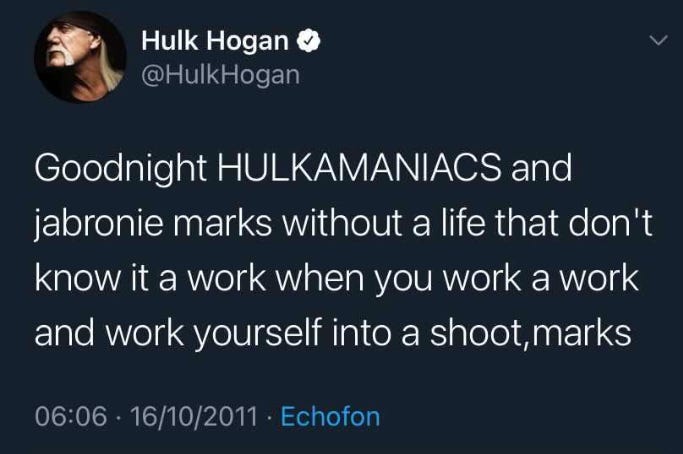
Ok, so…
If a work is fiction and a shoot is reality, then ‘working yourself into a shoot’ means you have gotten too invested in the fiction.
Some wrestlers start to get too invested in their characters. They refuse to lose because they think it will make them look bad. They get labeled difficult to work with. They take their fictional standings so seriously that they put their real life source of income in jeopardy.
You can work yourself into a shoot at your day job if you start taking it too seriously. You strive for the employee of the month award and you’re disappointed when you don’t get it. When there are internal job postings, you apply to them, because you think that the decision hasn’t been made already.
See Dwight Schrute from The Office: He’s the one most committed to Dunder Mifflin, yet he never advances. Michael clocks this, and placates him with an ‘assistant to the regional manager’ title, which means nothing to anyone except Dwight2.
The danger of working yourself into a shoot is that you start working for fictional rewards and missions, instead of doing what’s best for yourself and the bottom line. Remember that even at our 9-to-5s, we are all entrepreneurs, whether we like it or not.
Playing with corporate kayfabe
When you understand Kayfabe, something magical happens: Work becomes a lot more fun. You become more high-agency at work. You see what’s in Kayfabe and what isn’t. You see the lines, and know when to believe and when to play along.
Kayfabe is a collaborative construct after all, which means you get a vote. You can have some creative control over your character and their narrative.
If you can get yourself over without breaking kayfabe, or working yourself into a shoot, who is going to stop you from climbing up the card?
Maybe, if you want, you’ll even be in the main event one day. Or at least, you’ll be able to sell some more merch.
I got the idea for this essay after reading How to Talk to Pro Wrestling Fans about Prison Abolition. If you enjoyed reading this, I urge you to pick up a copy or make a donation.
From The Gervais Principle.